From Matthews, NC all the way to San Jose, CA and ever town in between you’ll find many kids (and parents) that quietly have the same misconception: “If I’m not the best, I’m bad.” This all‑or‑nothing thinking crushes confidence and makes kids afraid to try. The performing arts, when guided by a seasoned teacher, can gently flip that script so kids learn to be brave, not perfect.
Why Perfectionism Shows Up So Young
By elementary and middle school, many kids are already hearing and thinking:
-
“I messed up once; I’m terrible at this.”
-
“That kid is better than me, so why should I even try?”
-
“If I don’t get the lead / a solo / a top score, I failed.”
Perfectionism often hides inside “high standards,” but it causes kids to avoid challenges and any feedback received seems like a personal attack.
At CAM, our goal isn’t to lower standards, it’s to raise resilience—so kids can go for big things without falling apart when it’s not flawless. After all, we learn much more from failure than we do from success!
Building Confidence Through “Safe Imperfection”
Theatre is almost designed to break perfectionism in a kind way. “Even in the most technically elaborate productions with a cast of Broadway stars, lines are dropped, cues are missed, a mic doesn’t work, and a prop gets tangled with a curtain,” says Regina Ziliani, owner of CAM and Executive Director of SHINE Musical Theatre. “I’ve seen it all happen on Broadway and on professional Broadway tours. Yet the professionals know the show must go on, and as all theatre people do, they figure it out! That is a life skill everyone can benefit from.”
Here’s the lesson: Mistakes are Survivable. In theatre, every cast member is equally important, and they rely on each other as any good team does. There is safety in knowing you have a supportive cast to lean on. That kind of atmosphere is the perfect place for kids and teens to take artistic risks and build their confidence! And theatre doesn’t just make kids brave on stage. It makes them more brave everywhere.
The Power of Private Music Lessons
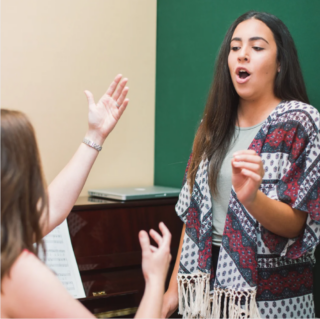
Students who take private lessons add a different ingredient: focused attention from a master teacher who can tailor the work to one child’s personality, fears, and goals. Like in theatre, a music student has a contained space to fail and problem solve how to make their music better. An experienced teacher helps the student learn that its OK for a song to fall apart because their teacher is there to guide them through the process. Honest, gentle coaching with specific feedback goes a long way in building the student’s confidence and willingness to challenge themselves.
A master teacher also understands that praise of the student should be process-based. Instead of “You’re so talented,” they might say “You really stuck with that difficult rhythm and its getting better each time you try!” An experienced teacher also adjusts their teaching for each student’s learning style, motivation, and goals.
Theatre + Private Lessons: The Confidence Building Formula
There is magic in this combination. In private lessons, kids build their skills. They practice, fix, and improve under the guidance of their teacher. The teacher also helps the student choose and prepare for auditions, competitions, and recitals. Vocal students in particular benefit from the private lessons/theatre combo. The skills taught in private voice lessons prepare the student all the way from production auditions as they choose the perfect song and work on the audition cut, all the way to the performance. And over time the student begins to realize…
-
“I am someone who finishes what I start.”
-
“I can be nervous and still perform.”
-
“I can make mistakes and still be proud of myself.”
That’s confidence without perfectionism.
How Parents Can Support This Mindset
Parents play a vital role in supporting their child in the performing arts. It goes far beyond driving them to and from practices. A focus on the process is important in the home. For example, parents can say “I loved how you kept going when you forgot the word” which is much better than “You are so talented.” Also, asking process-focused questions is terrific. For instance, as “What felt difficult today?” or “I’d love to hear how you tweaked that song today to make it even better.” Parents can also normalize nerves. “It makes sense you are nervous because it shows this matters to you.”
At Charlotte Academy of Music, we care more about who your child becomes than about a ‘perfect’ performance. Through theatre and one‑on‑one work with master teachers, we help kids build the kind of confidence that lasts longer than any show: the belief that they can try, fall short, and try again, and that there is so much value in that journey.